
Europe is not stepping back from sustainability; it is tightening the logic of proof
The hospitality sector should pay close attention. Tourism remains one of Europe’s most important economic ecosystems. The European Commission’s industrial ecosystem monitor states that tourism generated 7% of EU value added and 20.3 million jobs in 2019, while Eurostat reported that 2025 set another record for tourism demand, with nearly 3.1 billion nights spent in tourist accommodation across the European Union. In other words, the sector is large, politically relevant, and commercially significant. When a market of that scale raises the bar on sustainability language, reporting, building performance, product circularity, and certification credibility, the ripple effects do not remain inside Brussels. They travel through brands, owners, lenders, OTAs, tour operators, corporate travel buyers, public procurement, and guest expectations.
This matters even for hotels outside the EU. Not every independent property in Latin America, the Caribbean, the Middle East, or Asia will be directly subject to every European instrument. But many will feel the effect indirectly through European source markets, European management companies, European investors, European intermediaries, or marketing aimed at European consumers. In practice, Europe is not only regulating companies within its territory. It is shaping the evidentiary culture of global hospitality.
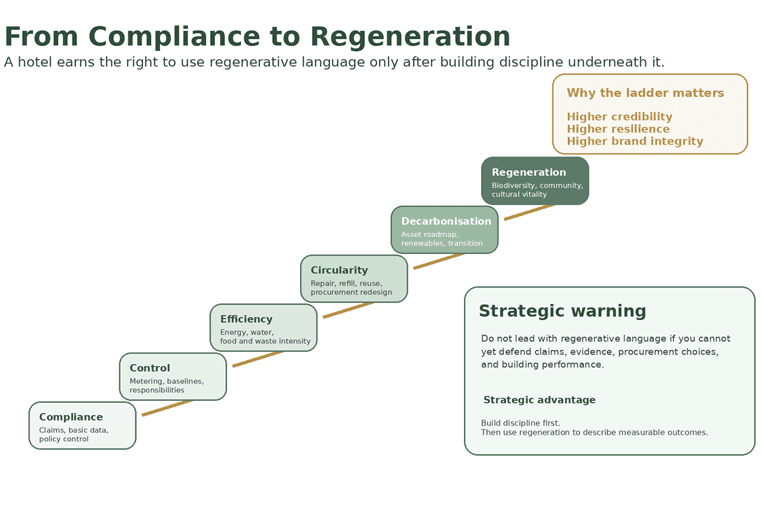
For regenerative hospitality, that is a critical distinction. Sustainability and regeneration are not the same. Sustainability asks how to reduce harm, improve efficiency, and remain within ecological and social limits. Regeneration asks a more ambitious question: how can a hotel, retreat, or destination actively restore ecosystems, strengthen community prosperity, reinforce cultural continuity, and deepen the health of place? Yet the legal shift underway in Europe does not weaken regeneration. It strengthens it. Why? Because the more ambitious the claim, the greater the need for proof.
Diagram 1. The 2026 proof stack for hospitality

The regulatory shift is no longer limited to reporting. It connects consumer communication, disclosure, procurement, packaging, building performance, and certification quality into one strategic system.
From green storytelling to substantiation
The most decisive development for hospitality communication is Directive (EU) 2024/825 on empowering consumers for the green transition. Member States had until 27 March 2026 to transpose it, and the rules apply from 27 September 2026. The directive amends the Consumer Rights Directive and the Unfair Commercial Practices Directive. Its underlying message is simple: consumers must receive clearer, more reliable information, and businesses must not rely on vague, inflated, or unsubstantiated environmental messaging.
This matters enormously for travel and hospitality, because the sector often communicates through broad emotional language: eco-luxury, conscious travel, green hotel, climate-friendly stay, responsible retreat, planet-positive experience. Under the new approach, those formulations become much harder to defend if they are generic, not precisely bounded, or not backed by recognised evidence. The directive explicitly targets practices such as displaying a sustainability label that is not based on a certification scheme or established by public authorities, and making a generic environmental claim without being able to demonstrate recognised excellent environmental performance relevant to the claim.
In strategic terms, Europe is moving the market from atmospheric language to technical language. A hotel will increasingly need to say not simply that it is ‘sustainable’, but what exactly has improved, by how much, across what boundary, against which baseline, using which methodology, and under what form of verification. The difference between those two communications is the difference between brand rhetoric and compliance-ready positioning.
At the same time, it is essential to distinguish between what is already law and what remains proposed. The Green Claims Directive has not entered into force. The Commission proposal from March 2023 remains a proposal, and current parliamentary tracking shows trilogue negotiations on hold. However, dismissing it would be a strategic mistake. Even in its current form, the proposal has already shaped the standard of seriousness in the market: science-based substantiation, relevance to the whole claim, life-cycle awareness, transparent treatment of offsets, and scrutiny of environmental labelling schemes. In other words, even before becoming law, it has influenced what sophisticated buyers and credible certifiers now consider good practice.
This is one reason certification is becoming more strategic. Europe is not saying that every hotel must use the same label. It is saying that the era of self-declared sustainability symbols, undefined logos, and unverified superlatives is ending. That is precisely why recognised schemes, properly governed conformity assessment processes, and transparent methodologies are gaining relevance.
Reporting has been simplified, not rendered irrelevant
A second major lesson for hospitality leaders is that reporting has not disappeared. It has been simplified, narrowed, and partially delayed, but not cancelled. The first companies subject to the Corporate Sustainability Reporting Directive (CSRD) had to apply the new rules for the 2024 financial year, with reports published in 2025. That wave is already real. What changed afterward is the breadth and timing of the next stages.
Following the Omnibus I simplification process, the Council gave final green light in February 2026 to updated sustainability reporting and due diligence rules. The CSRD scope was narrowed to companies with more than 1,000 employees and above EUR 450 million net annual turnover, together with revised thresholds for certain third-country undertakings. The amended framework also created a transition exemption for wave one companies that now fall out of scope for 2025 and 2026. In parallel, the Corporate Sustainability Due Diligence Directive (CS3D/CSDDD) was also narrowed, with the new threshold raised to more than 5,000 employees and EUR 1.5 billion turnover, and the transposition deadline postponed to 26 July 2028, with company compliance from July 2029.
Some executives have interpreted these changes as a signal that Europe is retreating from sustainability. I believe that is the wrong reading. The better reading is this: Europe is trying to reduce unnecessary reporting burden while preserving a high-integrity architecture around market claims, product standards, financial credibility, and the responsibilities of the very largest companies. Simplification is not the end of sustainability. It is a recalibration of where the burden sits.
For hospitality groups, the implication is practical. Large groups in scope must still invest in governance, data quality, double materiality logic, and internal control over sustainability information. Groups outside direct scope should not become complacent, because information demand will continue to travel through the value chain, albeit with more limits on what smaller companies can be asked to provide. Asset managers, institutional owners, banks, insurers, corporate travel buyers, and public-sector clients are unlikely to stop asking for structured environmental and social data merely because scope thresholds have changed.
In luxury hospitality, this becomes even more relevant. Premium positioning attracts premium scrutiny. The more a brand speaks about wellbeing, biodiversity, local sourcing, decarbonisation, cultural stewardship, or regenerative value, the more it must be able to demonstrate process discipline behind the narrative.
Table 1. 2026 European sustainability map for hospitality leaders
Instrument | Status as of April 2026 | Practical implication for hotels and travel brands |
Directive (EU) 2024/825 | Transposition deadline: 27 Mar 2026. Applies from 27 Sep 2026. | Generic or weakly substantiated environmental claims become far riskier in consumer-facing communication. |
Green Claims Directive | Still a proposal. Trilogues currently on hold. | Use it as the emerging benchmark for how serious environmental substantiation should look. |
CSRD / ESRS | Wave one reporting already started. Scope narrowed after Omnibus I to >1,000 employees and >EUR 450m turnover. | Large groups still need robust reporting systems. Smaller players will still feel structured data requests through portfolios and markets. |
CSDDD / CS3D | Scope narrowed to >5,000 employees and >EUR 1.5bn turnover. Transposition by 26 Jul 2028. Compliance from Jul 2029. | Very large groups must continue building due diligence capability; supply-chain discipline remains strategically relevant. |
Right to Repair Directive | Applies from 31 Jul 2026. | Procurement should favour repairability, maintenance, spare parts, and longer product life. |
Packaging and Packaging Waste Regulation | Applies from 12 Aug 2026. | Amenities, food and beverage packaging, supplier deliveries, refill systems, and guest-facing waste communication all become more strategic. |
ESPR | In force since July 2024. Secondary measures continue to develop. | Future ecodesign and product-information requirements affect FF&E, textiles, appliances, and operating goods. |
EPBD recast | Member State transposition supported for 29 May 2026 deadline. | Renovation planning, HVAC strategy, controls, envelope improvement, and renewable integration move further into core capex decisions. |
EU Ecolabel for tourist accommodation | Active. Criteria revision is underway. | A credible scheme can support market trust, legal defensibility, cost efficiency, and regulatory preparedness. |
ESG Ratings Regulation | Applies from 2 Jul 2026. | Investor and lender ecosystems face tighter oversight, increasing the value of credible ESG information and methodologies. |
2026 is also the year of circular hospitality operations
Where 2026 becomes especially tangible for hotels is circularity. Three developments stand out. First, the Directive on common rules promoting the repair of goods must be applied by Member States from 31 July 2026. Second, the Packaging and Packaging Waste Regulation (PPWR) applies from 12 August 2026. Third, the Ecodesign for Sustainable Products Regulation (ESPR), already in force since mid-2024, continues to build the framework through which future product requirements, digital product information, durability, reparability, and circular performance will be specified.
For hospitality, these are not abstract product rules. They affect the entire operating model. A hotel is a dense ecosystem of products: mattresses, linens, towels, uniforms, minibars, lighting, HVAC components, cosmetics packaging, food and beverage formats, amenities, cleaning equipment, furniture, electronics, tableware, and back-of-house materials. If Europe is moving toward better repairability, greater circularity, tighter packaging discipline, and stronger product information, hotel procurement can no longer be treated as an administrative function detached from sustainability strategy.
The PPWR is particularly important because it addresses one of the most visible contradictions in hospitality: premium service delivered through excessive packaging. The regulation is designed to reduce unnecessary packaging, improve recyclability, encourage reuse and refill, and strengthen labelling clarity. For hotels, this intersects directly with bathroom amenities, laundry logistics, e-commerce fulfilment, food takeaway packaging, supplier deliveries, minibar formats, event operations, retail corners, and guest communications around separation and waste. What was once framed as an operational preference is becoming a regulatory design question.
The repair agenda matters as well. A regenerative or sustainable hotel cannot credibly celebrate craftsmanship and longevity while running a replacement-based internal economy. The right to repair logic reinforces a culture in which maintenance, refurbishment, spare parts, modularity, and extended product life are strategic assets. This has implications not only for environmental performance, but also for cost resilience, capital efficiency, and brand authenticity.
The ESPR strengthens the same direction of travel. It broadens the ecodesign logic beyond energy-related products and aims to improve circularity, energy performance, and other environmental sustainability aspects of physical goods placed on the EU market. For hotel groups, the strategic insight is clear: procurement teams, sustainability teams, engineering teams, and brand teams must work from a common specification philosophy.
Buildings, renovation, and the capital agenda
The asset itself is the next frontier. The recast Energy Performance of Buildings Directive (EPBD) strengthens the pathway toward a zero-emission building stock by 2050, and the Commission has been issuing guidance to support Member State transposition by 29 May 2026. The directive is part of a broader architecture linking energy performance, renovation, renewable integration, and decarbonisation of the built environment.
For hotel owners, operators, and investors, this is fundamental. Hospitality is an asset-heavy sector. Its carbon profile, cost structure, guest comfort, and resilience are deeply shaped by the performance of the building envelope, cooling systems, heating, ventilation, domestic hot water, controls, lighting, and on-site energy systems. Europe’s building agenda therefore speaks directly to capex strategy.
The challenge is especially acute in luxury and heritage assets. Many high-end hotels operate in historic buildings, coastal environments, islands, older urban structures, or architecturally sensitive properties. Retrofitting them is not simple. Yet that is precisely where leadership now matters. The most forward-looking projects will be those that reconcile decarbonisation with placemaking, biophilic quality, thermal comfort, acoustic quality, cultural authenticity, and design excellence.
This is an important point for regenerative hospitality: energy renovation is not just a technical retrofit. At its best, it becomes part of a broader redesign of the guest experience and the property’s relationship with place. A poorly insulated luxury hotel with inefficient systems and excessive cooling is not elevated by elegant language. A high-performing hotel that reduces operating waste while improving comfort, local material intelligence, and climate resilience is.
Table 2. High-risk hospitality claims and stronger alternatives
| Stronger formulation | Minimum evidence expected |
‘Eco-friendly hotel’ | State the specific attribute: for example, lower energy use per occupied room, certified renewable electricity, or verified water reduction. | Metered data, baseline, period covered, boundary of operations, and methodology note. |
‘Carbon-neutral stay’ | Disclose what was measured, which scopes are included, what remains residual, and how any neutralisation or compensation is treated. | GHG accounting method, scope boundary, emissions data, treatment of offsets, and date of verification. |
‘Zero-waste resort’ | Use a quantified statement such as diversion rate, food-waste reduction, refill adoption, or packaging elimination. | Waste-stream data, landfill definition, diversion methodology, and supplier or operator evidence. |
‘Regenerative hotel’ | Describe the place-positive outcomes: biodiversity recovery, community capability-building, local value retention, cultural stewardship, or watershed restoration. | Indicators, stakeholder process, periodic results, and ideally third-party review or certification support. |
Diagram 2. A regenerative claim becomes credible only when it rests on legal, operational, and evidentiary discipline