

What Regenerative Travel Truly Means: From Intention to Verified Impact
Regenerative travel is emerging as one of the defining ideas shaping the future of tourism. Yet to understand its true...
Read more → Hoteliers Embrace ‘Living Systems’ as Regenerative Tourism
There are moments in an industry when language begins to change because reality is changing first.
That is exactly what is happening today in hospitality.
For years, the global hotel sector has spoken the language of sustainability. It has invested in more efficient technologies, reduced single-use plastics, measured energy use more carefully, redesigned procurement policies, and tried, with varying degrees of seriousness, to lessen its negative impact. All of that has been necessary. All of that remains valuable. But for an increasing number of hotel owners, general managers, asset managers, and destination leaders, one truth is becoming unmistakably clear: sustainability alone is no longer enough.
The question is no longer whether hotels should reduce harm. The question is whether they are prepared to create tangible positive value for the places, communities, ecosystems, and cultures that make hospitality possible in the first place.
That is why more hoteliers are beginning to embrace a living systems approach, and why regenerative tourism is emerging as one of the most important strategic frameworks of the next decade.
At ITB Berlin 2026, this shift was no longer theoretical. It was visible, explicit, and increasingly central to the future of the industry. ITB Berlin’s 2026 Convention was held from 3 to 5 March under the theme “Leading Tourism into Balance,” a motto that perfectly captured the growing recognition that tourism can no longer be assessed only through volume, growth, and financial return, but must also be judged by its capacity to support a healthy equilibrium between business performance, environmental stewardship, and social value.
It was in that context that I had the privilege of taking part as a speaker at ITB Berlin alongside Alessandro Inversini and Valentina Clergue in the session “The Luxury We Are Leaving Behind: Why Regenerative Hospitality is the Future.” The session appeared in the official 2026 ITB Berlin Convention programme and reflected a conversation that is now gaining real momentum across luxury hospitality: the model of luxury we inherited is no longer sufficient for the world we are entering.

That title was not chosen for effect. It was chosen because it expresses a structural reality.
The old model of luxury hospitality was often designed around separation. Separation from place. Separation from seasonality. Separation from local production systems. Separation from social reality. Separation, in many cases, even from the ecological limits of the destination itself. It was a model that celebrated aesthetic refinement, privacy, exclusivity, abundance, and service perfection, but too often did so without asking a deeper question: what is the long-term consequence of this model for the place that hosts it?
Today, that omission is no longer acceptable.
The destinations that sustain tourism are under pressure. Water systems are under pressure. Biodiversity is under pressure. Heritage is under pressure. Community trust is under pressure. Workforce wellbeing is under pressure. And hotels, particularly those in the premium and luxury segment, are being called to respond with greater maturity, greater accountability, and greater imagination.
This is where the distinction between sustainability and regeneration becomes critical.
UN Tourism defines sustainable tourism as tourism that takes full account of current and future economic, social, and environmental impacts, while addressing the needs of visitors, the industry, the environment, and host communities. That remains an essential reference point and one the sector should not dilute. Sustainability, at its best, creates discipline. It establishes responsibility. It encourages efficiency, compliance, mitigation, and more careful resource use.
But regenerative tourism asks something more ambitious.
It asks whether tourism can leave a place better than it found it. It asks whether a hotel can actively contribute to healthier ecosystems, stronger local economies, more dignified employment, more authentic cultural continuity, and more meaningful guest transformation. It is not only about reducing damage. It is about generating renewal.
This is precisely why sustainable tourism and regenerative tourism should never be treated as interchangeable concepts.
Regeneration is not a fashionable synonym for sustainability. It is the next strategic evolution of it.
In practical terms, sustainability often focuses on minimizing negative impact. Regeneration focuses on improving the health of the system. Sustainability can sometimes be implemented through technical fixes and operational controls. Regeneration requires a deeper redesign of relationships. Sustainability frequently asks how to maintain. Regeneration asks how to restore, revitalize, and enable conditions for life to flourish again.
That is why the language of living systems matters so much.
A hotel is not an isolated product. It is not a sealed commercial object sitting outside the territory that surrounds it. It is part of a living system composed of land, water, energy, architecture, food systems, staff, guests, local culture, supply chains, public institutions, social memory, and community aspirations. Every operational decision made by a hotel reverberates across that system. Procurement choices shape local value creation. Water practices affect community resilience. Design decisions influence biodiversity, thermal comfort, and cultural coherence. Employment practices shape dignity, stability, and local trust. Guest programming shapes how visitors relate to place.
When we understand hospitality as participation in a living system, management changes.
We begin to ask different questions.
Not only: How do we save energy?. But also: How do we restore ecological intelligence to the built environment?
Not only: How do we reduce waste?. But also: How do we redesign operations around circularity, local sourcing, and material responsibility?
Not only: How do we support the community?. But also: How do we ensure the community genuinely benefits, has voice, and co-creates value?
Not only: How do we satisfy the guest?. But also: How do we offer a guest experience that is emotionally meaningful, culturally respectful, and regenerative for both visitor and destination?
This is the real paradigm shift now entering hospitality leadership.
And it is not ideological. It is strategic.
Hotels that fail to evolve may still perform for a time, but they will become increasingly fragile in a world that is demanding proof, transparency, and deeper legitimacy. By contrast, those that understand regeneration as an operating model, not a marketing narrative, are likely to build stronger reputations, more resilient destination relationships, more committed teams, and more durable long-term value.
That is one of the reasons why ITB Berlin 2026 felt especially significant.
This year, regenerative hospitality entered the arena of mainstream industry dialogue. And when that happens at a platform as globally influential as ITB Berlin, the signal is unmistakable: the market is beginning to move.
For REGENERA LUXURY, ITB Berlin 2026 was particularly important because it was also the stage on which the Regenera Luxury Hospitality Awards were unveiled.
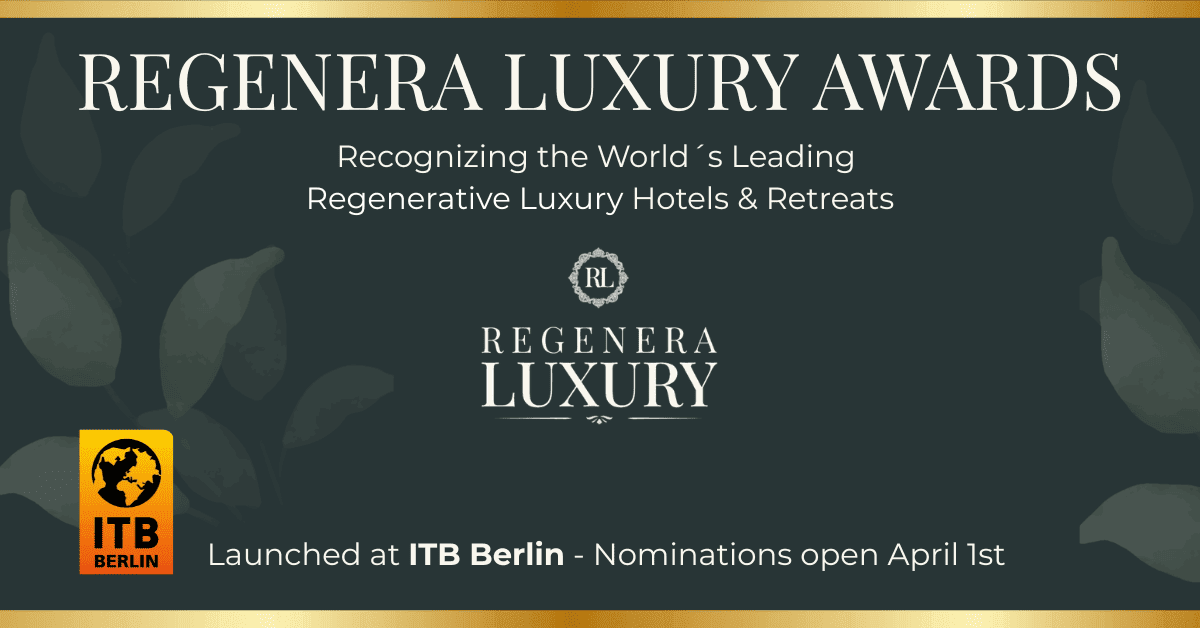
These awards were created with a very clear purpose: to move hospitality recognition away from perception and closer to verified impact. According to the official framework, the Regenera Luxury Hospitality Awards are the world’s first data-driven awards for regenerative hospitality, created to recognize hotels that generate measurable positive impact for nature, communities, culture, and people. They were officially unveiled at ITB Berlin 2026 and are built around performance data, transparency, and evaluation rather than reputation alone.
This matters enormously.
Hospitality has many awards, but very few of them fundamentally challenge what the industry rewards. Too often, recognition has been based on visibility, prestige, branding, aesthetics, or guest perception, all of which have value, but none of which are sufficient to define leadership in the era we are entering.
If a hotel claims to be regenerative, we must ask: where is the evidence?
The structure of the Regenera Luxury Global Hospitality Awards addresses precisely these questions. The awards are open to any hotel worldwide. Entry does not require prior certification, but it does require baseline analysis. Hotels are evaluated through the Regenera Luxury Regenerative Management System, which reviews operational performance across environmental stewardship, governance and transparency, community impact, cultural preservation, staff wellbeing, and guest engagement. Winners are determined through KPI performance and performance scores, not through subjective narrative alone.
The official awards calendar is equally important because it confirms that this is not a symbolic initiative, but a real operational platform. The awards were launched at ITB Berlin in March 2026. Nominations open on 1 April 2026, close on 30 June 2026, the review period runs through July and August, and the global winners announcement is scheduled for September 2026.
The award categories themselves reveal the direction in which hospitality is moving. They include the Regenerative Leadership Index, Most Improved Potential Award, Best Regenerative Governance and Data Transparency, Supply Chain Traceability and Local Value Creation, Water Stewardship and Net-Positive Pathway, Circularity Champion, Biodiversity and Landscape Regeneration Leader, Staff Wellbeing and Human Development Leader, Cultural Heritage and Community Partnership Excellence, and Best Guest Participation in Regeneration. These are not ornamental categories. They are a new language of excellence for a new era of hotel leadership. Rooted in values, proven through data.
I believe this is one of the most important developments in the hospitality sector today.
Why?
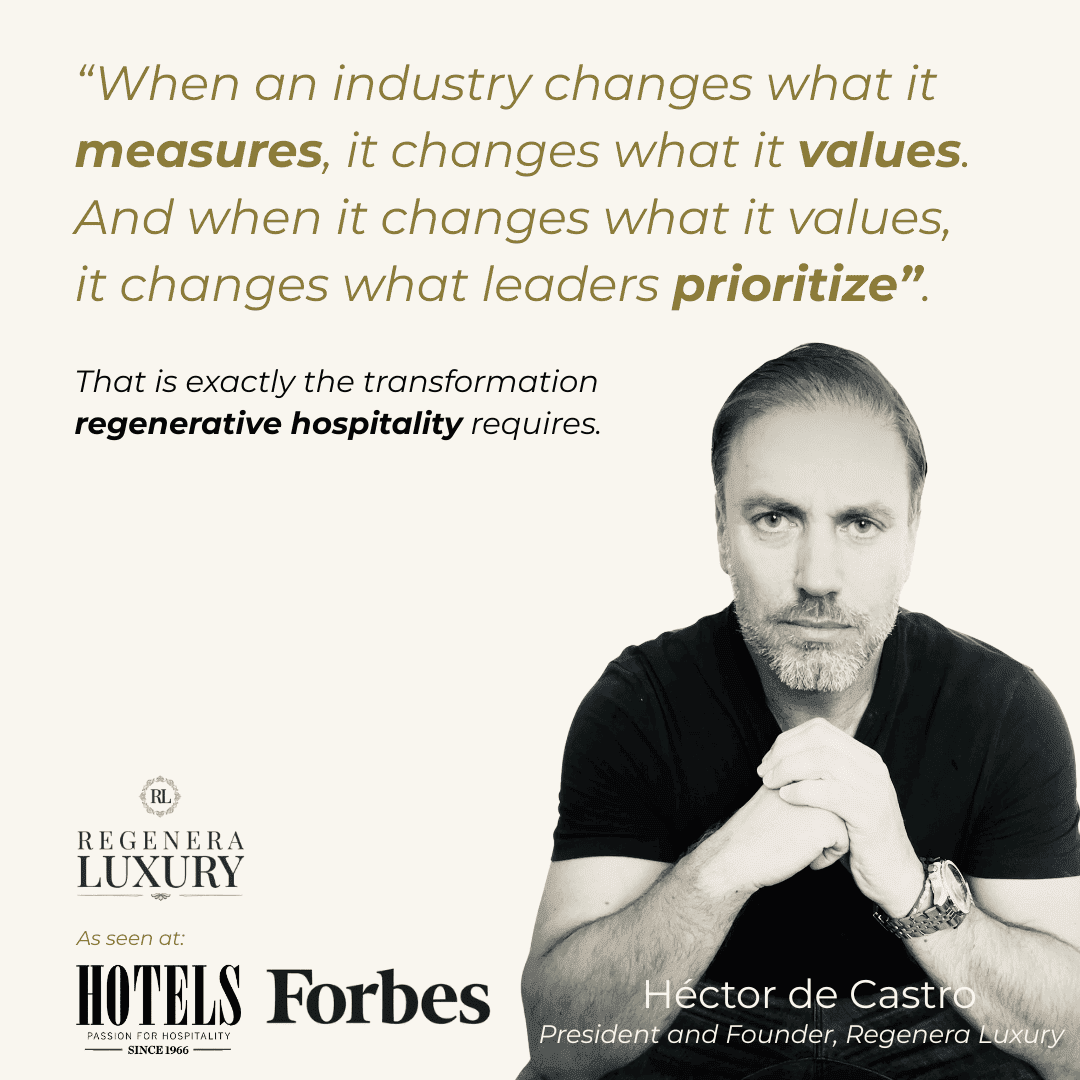
Because when an industry changes what it measures, it changes what it values. And when it changes what it values, it changes what leaders prioritize. That is exactly the transformation regenerative hospitality requires.
The luxury hotel of the future will not be admired only because it is beautiful. It will be admired because its beauty is coherent with the health of its place. It will not be respected only because it delivers personalized service. It will be respected because its service culture extends dignity to employees, suppliers, and local stakeholders as well. It will not be differentiated only because it tells a compelling story. It will be differentiated because the story is supported by data, by operational depth, and by visible positive outcomes.
This is especially relevant for boutique hotels, retreats, and independent luxury properties, where place-based identity is often the greatest source of strategic advantage. Regeneration allows such properties to move beyond generic sustainability claims and build a distinctive proposition rooted in territory, heritage, people, and measurable contribution. It enables them to become not simply “less harmful” versions of conventional hospitality, but active contributors to the renewal of the destinations they inhabit.
That is the heart of regenerative luxury.
And it is also why I remain convinced that the future of hospitality leadership belongs to those who understand that business success and destination health are not competing goals. They are interdependent goals.
A hotel cannot prosper indefinitely in a place that is being depleted.
A brand cannot sustain meaning if its social and ecological context is deteriorating.
A guest experience cannot remain truly exceptional if the culture around it is reduced to staging, the landscape around it is under stress, and the people behind it are overburdened.
Regeneration is therefore not an optional ethical layer added after the business model is built. It must become part of the business model itself.
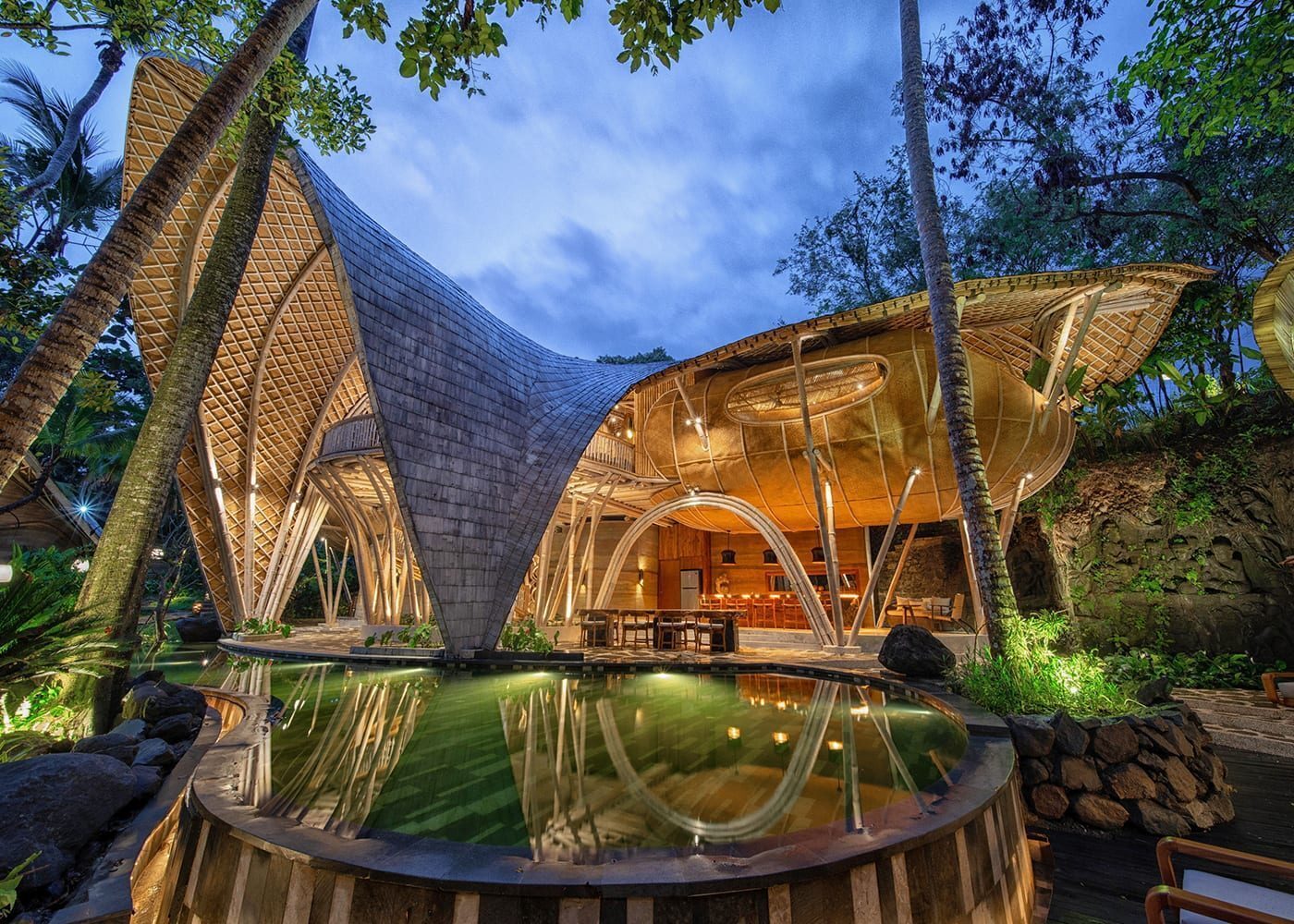
Ulaman Bali, nominee for Regenera Luxury Awards
At Regenera Luxury, we have long argued that sustainability should be regarded as the baseline, not the finish line. The unveiling of the Regenera Luxury Hospitality Awards at ITB Berlin 2026 gives that conviction a new and more visible platform. It signals that the sector is ready, or at least increasingly ready, to move from declarations to evidence, from aspiration to methodology, and from symbolic responsibility to measurable regenerative leadership.
The conversation I had the honor to share at ITB Berlin with Alessandro Inversini and Valentina Clergue reinforced this point powerfully. The future of hospitality will not be defined by who is best at polishing the legacy model. It will be defined by who is courageous enough to redesign it.
That redesign begins with humility. It begins with recognizing that no hotel, no matter how luxurious, exists independently of the ecological and social conditions that sustain it.
It continues with systems thinking. It requires moving beyond fragmented initiatives and seeing the property as part of a wider web of relationships. And it succeeds only when that thinking becomes operational.
Not in speeches alone. Not in brochures alone. Not in annual reports alone. But in management systems, in verified KPIs, in procurement contracts, in staff training, in capital planning, in guest touchpoints, in community partnerships, and in governance decisions. This is where regenerative tourism stops being an idea and becomes a discipline.
For hotel owners, general managers, and hospitality leaders reading this, the message is clear: The industry is changing.
Guests are becoming more discerning. Destinations are demanding more reciprocity. Teams are seeking more purpose and better wellbeing.
Institutions are expecting more transparency. And the most credible forms of recognition will increasingly reward those who can demonstrate measurable positive impact.
The hotels that understand this earliest will not simply adapt faster. They will help define the standards by which the rest of the market will eventually be measured.
That is why I see this moment with optimism. Not because the challenges are small. They are not. But because hospitality still has something extraordinary that few industries possess: the ability to shape how people encounter places, cultures, landscapes, and one another.
To create luxury that does not distance itself from life, but deepens its relationship with it.
And after what we witnessed at ITB Berlin 2026, I am more certain than ever that the future belongs to those ready to embrace it.
If your hotel is ready to move from sustainability to measurable regeneration, this is the moment to begin. Regenera Luxury is working with owners, general managers, and hotel teams to accelerate that transition through methodology, assessment, certification, strategic positioning, and now, global recognition through the REGENERA LUXURY Hospitality Awards.
The future of hospitality will belong to the hotels that do not simply operate in a destination, but help it flourish.
Regenerative travel is emerging as one of the defining ideas shaping the future of tourism. Yet to understand its true...
Read more →
Strategic Alliance: Regenera Luxury x Ownia Collection, Regenera Luxury is proud to announce a strategic partnership with Ownia Collection, a...
Read more →
Europe’s sustainability framework is reshaping the future of hospitality. In 2026, luxury and boutique hotels can no longer rely on...
Read more →